


Business class travel consolidators negotiate bulk discounts directly with airlines, giving companies access to premium cabin fares at significantly reduced prices. They streamline corporate travel policy compliance, simplify expense reporting, and offer exclusive upgrade opportunities—making them a practical solution for organizations that prioritize both cost control and traveler comfort.
Corporate travel budgets are under more scrutiny than ever. Finance teams want transparency. Travelers want comfort. And travel managers want a process that doesn’t fall apart the moment a flight gets canceled. Business class travel consolidators have emerged as one of the most effective answers to all three demands simultaneously.
Unlike traditional travel agencies that simply mark up available fares, business class travel consolidators operate through direct relationships with airlines. They purchase seats in bulk, negotiate volume-based pricing, and pass a meaningful portion of those savings on to corporate clients. The result is premium cabin access at rates that would be impossible to find on a standard booking platform or airline website.
This isn’t a niche workaround for large multinationals. Increasingly, mid-sized companies and even growing startups are integrating business class travel consolidators into their travel programs—and seeing measurable results in both cost reduction and traveler satisfaction.
This guide breaks down how business class travel consolidators work, what they offer beyond the price tag, how they compare to traditional booking methods, and what to look for when choosing the right partner for your organization’s travel needs.
What Are Business Class Travel Consolidators?

Business class travel consolidators are specialized travel service providers that negotiate discounted fares directly with airlines—primarily for premium cabin seats including business and first class. Rather than functioning as retail agents, consolidators act more like wholesale buyers, securing large blocks of seats at contracted rates and making them available to corporate clients.
The core value proposition is straightforward: airlines benefit from guaranteed seat occupancy, and consolidators benefit from the margin between the contracted rate and the price charged to clients. Corporations, in turn, gain access to premium air travel at prices that reflect none of the inflated retail markups typical of direct airline bookings or online travel agencies.
Most established business class travel consolidators also operate in alignment with International Air Transport Association (IATA) standards. IATA accreditation signals that a consolidator adheres to recognized industry regulations, financial reliability requirements, and quality benchmarks—an important factor when evaluating potential partners.
How do consolidators negotiate bulk discounts with airlines?
Consolidators typically approach airlines with volume commitments—guaranteeing a certain number of seat purchases across a defined period. This gives airlines predictable revenue and load factor improvements. In return, consolidators receive net fares, which are rates that fall below the published prices available to the general public.
These agreements are often route-specific and alliance-driven. A consolidator with strong partnerships across Star Alliance, Oneworld, and SkyTeam networks can offer corporate clients remarkable flexibility across international routes—a key advantage for companies with globally distributed teams.
Benefits of Using Business Class Travel Consolidators
Cost savings on premium cabin bookings
The most immediately visible benefit of working with business class travel consolidators is the reduction in premium cabin costs. Business class fares on long-haul international routes can run anywhere from $3,000 to over $15,000 per seat. Consolidators routinely offer access to those same cabins at discounts ranging from 20% to 60% off published fares, depending on the route, airline, and booking timing.
For companies with frequent business travelers, that margin compounds quickly. A team of ten making four international trips annually could realistically save six figures in travel spend by routing bookings through a consolidator rather than purchasing directly.
Simplified expense management and corporate travel policy compliance
Business class travel consolidators typically provide centralized booking platforms that integrate with corporate expense management tools. This means travel spend is automatically categorized, documented, and reportable—eliminating the manual reconciliation that plagues unmanaged travel programs.
Consolidators also make it easier to enforce travel policies. Approved vendors, cabin class rules, and spending caps can be embedded directly into the booking workflow, reducing the likelihood of policy exceptions and out-of-pocket reimbursements.
Access to exclusive fares and upgrade opportunities
Consolidators often hold access to unpublished fares that never appear on consumer-facing booking platforms. Beyond initial fares, many consolidator partnerships include upgrade pathways—mechanisms for moving travelers from premium economy to business class when inventory allows—further increasing the value per booking.
Enhanced business travel safety through vetted airline partnerships
Business class travel consolidators generally restrict their airline partnerships to carriers with strong safety records and established operational standards. This built-in filtering is one of the underappreciated business travel safety tips embedded in working with a reputable consolidator: you’re not just getting a cheaper fare, you’re booking through a partner that has already done the due diligence on carrier reliability.
How Business Class Travel Consolidators Work
The airline negotiation process
Negotiations between business class travel consolidators and airlines are typically conducted at the corporate or regional level, involving sales leadership on both sides. Consolidators present projected volume data and route demand, and airlines respond with tiered pricing structures tied to commitment thresholds.
These agreements are renewed regularly—often annually—and may be adjusted based on actual volume performance. The best consolidator relationships are dynamic, not static: they improve over time as a client’s travel volume increases and the consolidator’s leverage with airlines grows.
Volume-based pricing models and corporate account structures
Most business class travel consolidators use a tiered pricing model. Higher volume means access to deeper discounts and more favorable terms on flexibility and refundability. Corporate accounts are typically structured around an annual travel spend commitment or a projected number of segments.
Smaller companies or those new to consolidator programs can often access entry-level tiers, still enjoying discounts well below retail—even without the volume of a large enterprise.
Technology platforms that streamline booking and reporting
Modern business class travel consolidators are no longer just phone-and-fax operations. Leading providers offer self-service booking portals, mobile apps, and API integrations that connect directly with corporate travel management systems. Reporting dashboards give travel managers real-time visibility into spend by traveler, route, department, and policy compliance rate.
Business Class Travel Consolidators vs. Traditional Booking Methods
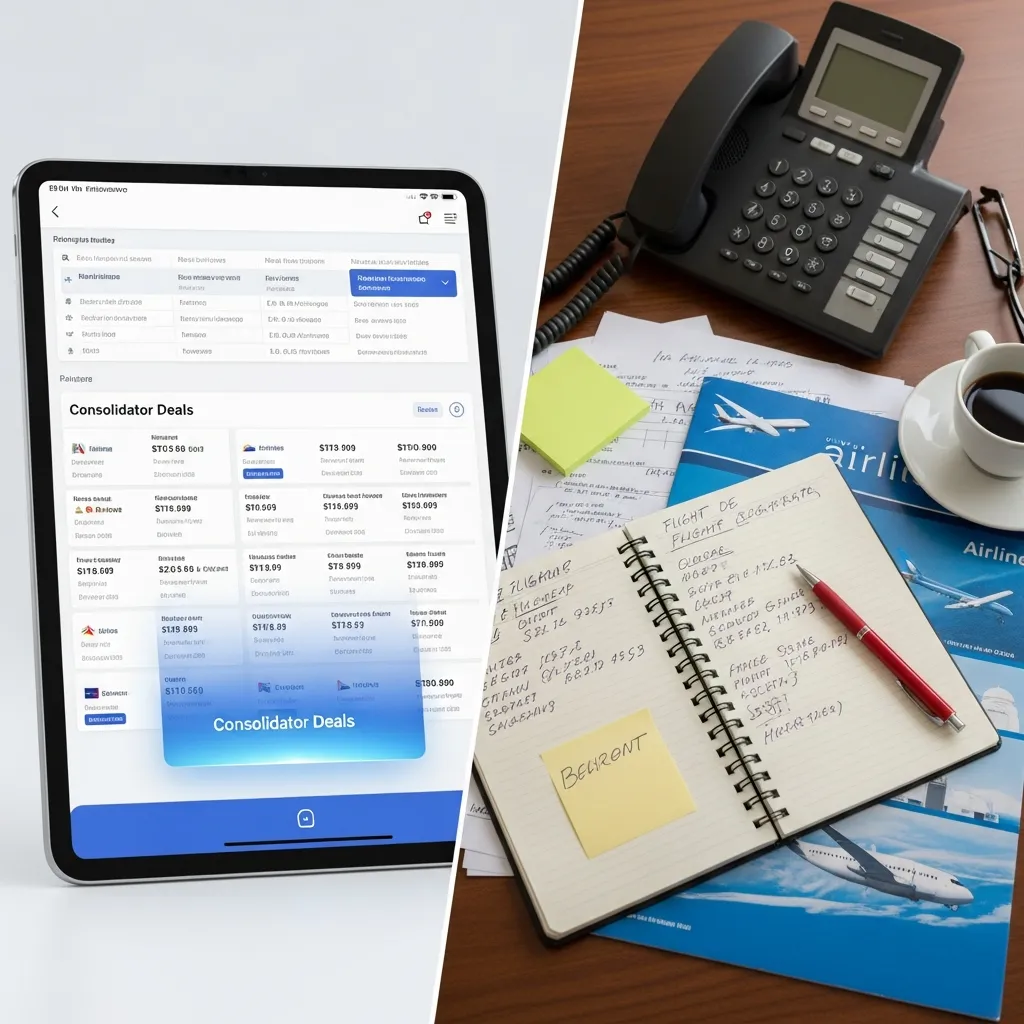
How do consolidators compare to online travel agencies and direct airline bookings?
Online travel agencies (OTAs) like Expedia for Business or TripActions aggregate publicly available fares and earn commissions on bookings. They provide convenience, but rarely offer the below-market rates that business class travel consolidators access through direct airline contracts.
Direct airline bookings give travelers full access to loyalty program accrual and flexible fare conditions—but at full published price. The cost differential can be substantial, particularly on long-haul or multi-city itineraries where premium cabin fares are highest.
Hidden fee transparency
Reputable business class travel consolidators operate with clear, upfront pricing. Unlike some OTAs that add service fees at checkout, established consolidators present all-in pricing inclusive of applicable taxes and charges. That said, it’s always worth clarifying refundability terms, change fees, and any service charges before confirming a corporate account.
Service quality and customer support advantages
The customer support model at most business class travel consolidators is oriented toward corporate accounts, not individual consumers. This means dedicated account managers, 24/7 traveler support lines, and proactive communication around disruptions—a meaningfully different experience from the generic support queues associated with consumer OTAs.
Smart Business Trip Planning with Consolidators
Smart business trip planning begins well before a booking is made. Integrating consolidators into your corporate travel program requires a few key steps:
- Policy alignment: Define which cabin classes are approved for which trip durations. Many companies permit business class for flights over six hours—a policy that consolidators can enforce automatically.
- Booking lead time: Consolidator fares are often available closer to departure than published fares, but locking in bookings two to four weeks in advance typically yields the strongest availability and pricing.
- Analytics integration: Use the reporting tools your consolidator provides to identify high-spend routes, frequent travelers, and opportunities for policy refinement.
Consolidators also make it easier to build in schedule flexibility. Many negotiated fares include change allowances that would cost significantly more on a standard published ticket.
Business Travel Safety Tips When Booking Premium Cabins
Safety is a non-negotiable element of any well-structured travel program. Here are key business travel safety tips relevant to premium cabin bookings:
- Airline safety records: Work with consolidators that restrict partnerships to IATA-certified carriers with strong operational histories. Avoid consolidators that offer unusually low fares on unfamiliar or unverified carriers.
- Travel insurance: Ensure corporate travel policies include comprehensive international coverage, including medical evacuation, trip interruption, and baggage protection. Consolidators often have preferred insurance partners with group rates.
- Emergency support: Confirm that your consolidator offers 24/7 traveler assistance for flight disruptions, missed connections, and medical emergencies. The best providers have on-call teams who can rebook and support travelers in real time.
- Documentation and compliance: For international travel, consolidators can flag destination-specific entry requirements, visa conditions, and health advisories—reducing the risk of travelers arriving underprepared.
Tennessee Tourist Destinations for Business Travelers
For companies routing travel through the American South, Tennessee tourist destinations offer a compelling mix of corporate infrastructure and leisure appeal. Cities like Nashville and Memphis function as growing business hubs with expanding convention center capacity, direct international flight access, and a thriving startup ecosystem.
Nashville, in particular, has attracted significant corporate investment in healthcare, technology, and financial services sectors. Business travelers will find a strong selection of premium hotels, conference venues, and executive dining—alongside genuine Tennessee tourist destinations like the Country Music Hall of Fame, the Parthenon replica in Centennial Park, and the culinary scene along Broadway.
For teams combining a corporate retreat with team-building, the Great Smoky Mountains National Park and Chattanooga’s waterfront district offer accessible day-trip options. Consolidators that manage leisure extensions on corporate trips can often apply negotiated rates to the full itinerary—making bleisure travel more affordable and easier to administer.
The Future of Corporate Premium Travel

Business class travel consolidators have moved well past their origins as simple fare wholesalers. Today, the best providers function as strategic travel partners—offering technology platforms, policy enforcement tools, safety infrastructure, and analytics capabilities that rival or exceed what most companies could build internally.
The long-term value of a consolidator relationship extends beyond per-ticket savings. Over time, the data generated through a consolidated travel program reveals spending patterns, traveler preferences, and optimization opportunities that inform smarter smart business trip planning across the organization. Airlines, meanwhile, are increasingly designing their consolidator partnerships to include loyalty integration—meaning travelers can often still accrue miles even on discounted fares, resolving one of the historic objections to consolidator bookings.
As remote and hybrid work models continue to reshape how companies think about in-person meetings and international collaboration, premium air travel will remain a meaningful line item. The organizations that manage that spend most effectively will be those with consolidator partnerships already in place—ready to scale as travel volumes increase and global business development accelerates.
For companies evaluating their options, the starting point is simple: identify your highest-frequency routes, estimate your annual premium cabin spend, and request rate comparisons from two or three accredited business class travel consolidators. The numbers will make the case clearly.
Frequently Asked Questions
How much can companies save with business class travel consolidators?
Companies typically save between 20% and 60% off published business class fares when booking through consolidators, depending on the airline, route, and contracted volume. On high-frequency international routes, annual savings can reach six figures for mid-sized travel programs.
Are consolidator fares refundable and flexible?
Refundability and flexibility vary by contract and fare type. Many consolidator fares include change allowances not available on equivalent published tickets. It’s essential to confirm specific terms—including change fees, cancellation policies, and refund timelines—before finalizing a corporate account agreement.
Which airlines partner with major business class travel consolidators?
Most established business class travel consolidators maintain relationships across major global carriers, including airlines within the Star Alliance, Oneworld, and SkyTeam alliances. Specific partnerships vary by consolidator and region, so confirming your key routes are covered is an important step during the evaluation process.
How do consolidators ensure International Air Transport Association compliance?
Reputable business class travel consolidators hold IATA accreditation, which requires adherence to financial, operational, and regulatory standards set by the International Air Transport Association. IATA accreditation is a baseline indicator of a consolidator’s legitimacy and industry standing.
Can startups and small businesses benefit from consolidators?
Yes. While the deepest discounts are typically reserved for high-volume accounts, many consolidators offer entry-level corporate tiers that still provide meaningful savings over retail fares. Startups with even a moderate frequency of international travel can benefit from consolidator pricing.
What is the typical booking lead time for consolidator fares?
Consolidator fares are often available closer to departure than standard published fares. However, booking two to four weeks in advance generally provides the best combination of availability, pricing, and seat selection—particularly for premium cabin bookings on popular routes.
How do consolidators handle flight changes and cancellations?
Most established business class travel consolidators offer dedicated traveler support teams available around the clock. In the event of a disruption, these teams can rebook, escalate with the airline directly, and coordinate alternative arrangements—typically faster than standard airline customer service channels.
Are there hidden fees in consolidator bookings?
Reputable business class travel consolidators present all-in pricing inclusive of taxes and standard charges. However, service fees, change fees, and ancillary charges vary by provider. Reviewing the full fee schedule before signing a corporate agreement is strongly recommended.
How do consolidators maintain business travel safety standards?
Business class travel consolidators maintain safety standards primarily through airline vetting—restricting partnerships to IATA-certified carriers with established safety records. Many also offer integrated travel insurance options and 24/7 emergency support to ensure traveler safety throughout the journey.
What technology integrations do consolidators offer with corporate systems?
Leading business class travel consolidators offer API integrations with major corporate travel management systems, expense platforms, and HR tools. Many provide self-service booking portals, mobile applications, and real-time reporting dashboards compatible with platforms like SAP Concur, Expensify, and similar enterprise tools.
How transparent is consolidator pricing compared to direct bookings?
Consolidator pricing is generally more transparent than it is often perceived. Established consolidators provide clear, all-in quotes that include applicable taxes and fees. In most cases, this transparency exceeds what travelers encounter when booking directly through airline websites, where upsells and ancillary fees are added progressively through the checkout process.
Can consolidators book international routes and multi-city itineraries?
Yes. Business class travel consolidators specialize in complex international itineraries, including open-jaw routes, multi-city trips, and around-the-world tickets. Their direct airline relationships often give them access to negotiated pricing on route combinations that would be expensive or difficult to assemble through standard booking channels.



Leave a Reply